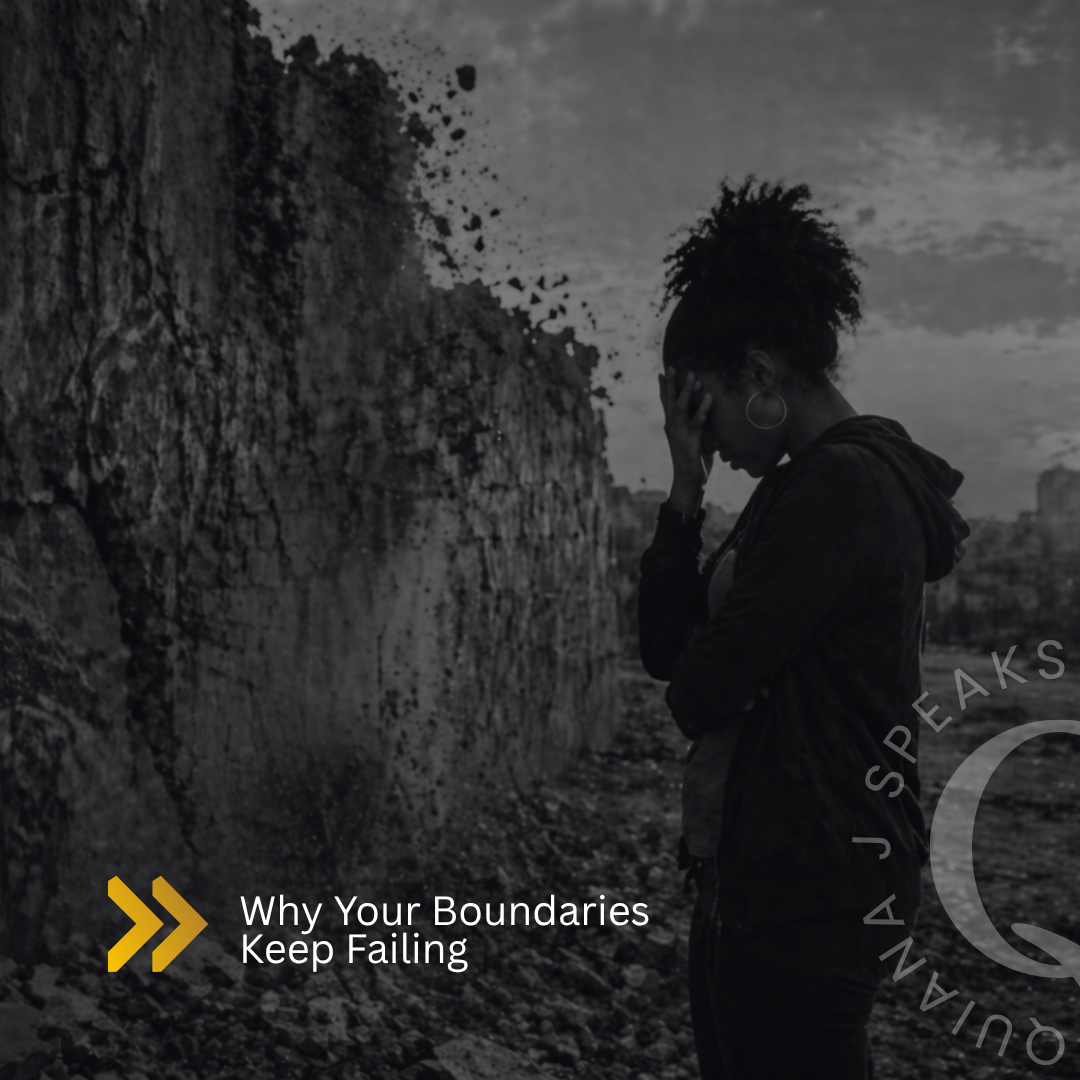
You’ve set the boundary before. Maybe more than once with the same person. You said what you needed to say.
You felt the clarity of it in the moment. And then, somewhere between the conversation and the follow-through, it disappeared. This is called “boundary-creep”. It is when you established a boundary but somewhere in the midst of confrontation and implementation, the boundary line shifts until it no longer exists.
And you ended up right back where you started — overextended, resentful, and quietly asking yourself why you can’t seem to make this stick.
I want to offer you a different diagnosis than the one you’ve probably been giving yourself.
The problem is not that you’re weak. The problem is not that you care too much. The problem is that you tried to build a fence on ground that wasn’t ready for it and that is a foundation issue, not a character issue.
The Ground Has to Be Ready First
Think about what it takes to build something that lasts. Before any structure goes up, the ground has to be assessed. You have to know what you’re working with — what’s stable, what’s compromised, what needs to be cleared before you can build anything on top of it.
Interior work is no different. When you try to establish boundaries without first doing the work of knowing who you are, what you value, and where you are still bleeding from old wounds, the boundary will not hold. Not because you didn’t mean it but because the ground it was built on was not ready to support it.
There are three areas of inner work that have to happen before your boundaries will become consistent. These are not three steps in a sequence, but three foundations that need to be laid simultaneously, each one informing the others.
Foundation One: Know Who Actually Has Access to You
One of the most common reasons boundaries fail is misplaced proximity. When someone is positioned closer to you than their character actually warrants, you will constantly be managing the fallout. You will keep being hurt by people you trusted too quickly and then spend enormous energy trying to protect yourself from the inside out.
Healthy limits begin with honest assessment. Not everyone who has been around a long time belongs in your inner circle. Not everyone who calls you their best friend has demonstrated the consistency, the care, and the character that the title implies. Longevity is not the same as loyalty. Familiarity is not the same as trustworthiness.
Think about it this way: in the Temple, not everyone had the same level of access to God, and that wasn’t a statement about who was loved more. It was a statement about what each space required and what each person was prepared to steward. The same principle applies to your relational world.
When you are honest about who belongs where (outer court, inner court, Holies of Holies), you stop expecting people to show up in ways they were never equipped to and when your expectations align with reality, you stop being devastated by the same disappointments on repeat.
Foundation Two: Know What You Actually Stand For
A boundary without a value underneath it is just a feeling and feelings shift with the room, with the mood, and with whoever is standing in front of you looking hurt.
But a boundary that is rooted in something you genuinely believe about yourself, now that is a different thing altogether. That kind of boundary doesn’t bend just because someone is uncomfortable. It holds because it is connected to something REAL inside you, something that does not move when circumstances change.
This is why the inner work of clarifying your core values is not optional. It is the infrastructure of everything else. When you know what you believe about your worth, your rest, your calling, and your relationships, the decisions become less complicated. You are not evaluating every situation from scratch. You are measuring it against something you have already decided.
Women who have done this work are not cold or inflexible. They are actually freer because they are no longer negotiating their standards every time someone pushes back. The decision was already made before the conversation started.
Foundation Three: Know Where You Are Still Wounded
This is the one most people want to skip and it is the one that will sabotage everything else if it’s left unaddressed.
Unhealed wounds don’t stay quiet when you start setting boundaries. They show up in the way you enforce them — or don’t. A woman who has not processed her fear of abandonment will cave the moment someone threatens to walk away. A woman who has not processed deep rejection will either have no limits at all or walls so high that no one can reach her. Both are extremes. Both are responses to pain rather than expressions of wisdom.
The question that needs honest reflection is not just “What are my boundaries?” but “Why do I enforce them the way I do?”
Are you drawing a line from a place of clarity, knowing what is healthy and choosing it? Or are you drawing it from a place of fear reacting to something that happened before this moment, in a different room, with a different person?
Both can look identical from the outside but they produce very different results over time. Clarity creates structure. Fear creates cycles.
What Happens When the Foundation Is Right
When these three things are in place, something shifts: honest relationship classification, grounded core values, and a willingness to face your wounds. The boundary stops feeling like a performance. It stops feeling like a confrontation. It starts feeling like something you simply are, rather than something you have to keep rebuilding.
People in your life begin to feel the consistency of it not because you have become rigid, but because you have become clear and clarity, communicated with kindness, is actually one of the most generous things you can offer the people around you.
It tells them the truth. It tells them who you are. It gives them something real to work with.
Biblical Bombshell: You were not made to be endlessly renegotiated. You were made to be known and people can only know you when you are willing to be clear about what that means.
💣 BIBLICAL BOMBSHELL: You were not made to be endlessly renegotiated. You were made to be known and people can only know you when you are willing to be clear about what that means.
🤗 Do me a favor:
If this post has resonated with you in any way, leave me a comment below.
If you think this post was impactful, share this post with someone you know or on social media.
🤩 Get the full teaching:
Watch Build Fences, Not Walls on my YouTube channel by clicking here.
Listen to Build Fences, Not Walls on the When Brokenness Speaks Inner Healing Podcast with Quiana J on Amazon Music, Apple Podcasts, Transister FM, PocketCasts, & Spotify.
Download this freebie: The Personal Boundaries Workbook
🎉 Get support in this area:
Book a :60 Inner Healing Life Coaching session with me by clicking here.
Learn more and enroll in Heirs + Daughters™ Inner Circle, my signature inner healing that fosters deep soul work through specialized healing journeys, content, accountability, coaching, & community by clicking here.